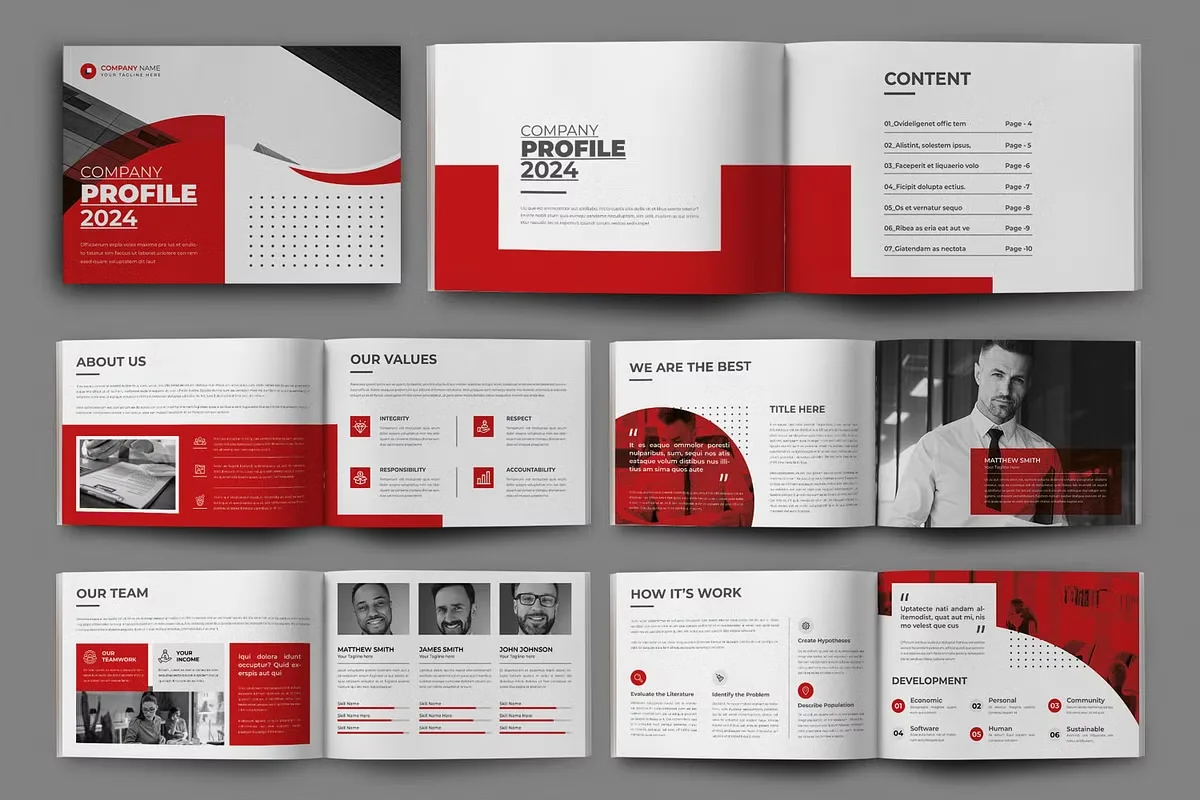
Every few years, someone writes a piece declaring that the company profile PDF is dead — killed by websites, LinkedIn, or some newer digital platform. And every time, the businesses that actually depend on tender submissions, investor diligence packs, and structured sales conversations keep using them, because the PDF serves specific jobs that websites do not. This article makes an honest case for understanding why company profile design is important in 2026 — not as a replacement for your website, but as a complementary tool that serves distinct contexts where your website genuinely falls short. No myths, no inflated claims. Just a clear-eyed look at what each format does well, and when you need both.
What Your Website Does Well
Your website is excellent at capturing inbound traffic, communicating brand personality, and converting visitors who arrive with an intent to explore. It is searchable, updated in real time, interactive, and accessible from any device. For most businesses, the website is the right place to invest first in digital communication — it does the broadest possible job of reaching, informing, and converting prospects across every stage of the funnel.
Your website also handles SEO ownership — it is the document that should rank for your primary keywords, attract organic traffic, and build domain authority over time. A PDF does not rank in the same way; it is not designed for discovery. Your website handles this discovery function comprehensively, and no other format should try to compete with it for that job.
Additionally, websites are self-updating in a way that PDFs are not. Blog posts, news updates, and product announcements all contribute to a dynamic online presence that signals business health and activity. A company profile, by its nature, is a snapshot — accurate at the time of publication, increasingly dated over time.
What a Designed Profile Does Differently
Despite all of the above, a designed company profile does several things that a website cannot. The first and most important is narrative control in an asynchronous context. When you email a profile to a procurement officer or include it in a tender submission, you control exactly what they see, in exactly what order, without the distractions, pop-ups, cookie banners, or navigation options that a website carries. The profile presents a curated sequence: here is who we are, here is what we do, here is why we are credible, here is how to reach us. This controlled sequence cannot be replicated by a website, which allows (and depends on) non-linear navigation.
A designed brand trust PDF also signals seriousness in a way that a website link does not, in certain contexts. Sending a well-designed PDF to a prospect before a meeting says, "we have invested in presenting ourselves professionally." It is a tangible artefact of the business's attention to quality. In industries where trust is built slowly and relationships matter — infrastructure, manufacturing, professional services, government contracting — this signalling has real commercial value.
Tenders and Portal Attachments
The most concrete and undeniable use case for a company profile in 2026 is tender and procurement portal submissions. GeM (Government e-Marketplace), state government portals, CPWD vendor registrations, and hundreds of corporate procurement platforms require a company profile as a mandatory attachment. They specify file type (PDF), size limits, and often content requirements. In these contexts, there is no alternative — a website link will not be accepted in place of an attached document.
For businesses that participate in public procurement, the tender PDF vs website debate is not really a debate at all. Both are needed, for entirely different reasons. The website builds the brand; the tender profile satisfies the compliance requirement. Skimping on the profile because "we have a good website" is a mistake that costs bids before evaluation even begins. Procurement evaluators often assess profiles before they visit the website — the profile is the first impression in this context, not the website.
For more on how a professional profile serves tender submission contexts, see our company profile design service, which specifically addresses tender-ready profiles alongside sales profiles.
Investor Diligence Requirements
Investor diligence is another context where a company profile plays a role that a website cannot. During a funding round — whether angel, VC, or PE — investors conduct systematic due diligence that requires a structured pack of documents. A company profile is typically one of the first documents requested, because it provides a clean, organised summary of the business without requiring the investor to navigate a website and piece together information from multiple pages.
Investor diligence documents need to be versioned, dated, and controllable. Sending an investor to your website introduces variables: the site may change between their first visit and their final decision, or different team members on their side may remember different versions of what they read. A PDF with a version number and date is a fixed reference point that both sides can cite. It also demonstrates organisational discipline — a messy or incomplete investor document suggests that other aspects of the business may be similarly disorganised.
The profile shared with investors will differ from the one used in sales contexts — it typically includes more financial context (at a high level), team credentials in greater depth, and a clearer articulation of market position and growth trajectory. But the design principles and the need for professional quality are the same.
Offline and Print Context
In-person sales meetings, industry exhibitions, client visits, and partner conferences still happen — and in many B2B sectors in India, they remain the primary context for relationship-building. A printed company profile, handed over at the start of a meeting, serves a function that a website demonstrably cannot: it gives the prospect something to hold, read, annotate, and share with colleagues after the meeting.
The offline sales meetings context is often underestimated by businesses that have moved entirely to digital communication. Studies of B2B sales consistently show that physical materials have recall advantages — a prospect who has held your printed profile is more likely to remember your business accurately than one who visited your website briefly. For high-value or long-cycle sales, where the decision involves multiple stakeholders and takes weeks or months, a physical profile that can circulate through an office without requiring internet access is a practical communication tool.
Print quality matters here in a way that digital quality does not. A poorly printed profile — with colour shifts, pixelated images, or cheap paper — signals the opposite of what was intended. The printing investment is modest relative to the credibility benefit, and a well-produced printed profile routinely outlasts the typical website visit by months.
When a PDF Controls the Narrative Better
There is a class of communications where narrative control is the primary requirement, and in these situations a designed PDF consistently outperforms a website. Legal and regulatory submissions require a fixed, citable document. Partnership proposals benefit from a structured format that walks the reader through a logical argument. Supplier qualification submissions need a consistent template that matches what other qualified suppliers have provided.
Websites are designed for exploration and discovery — they assume a reader who wants to find specific information in their own sequence. A PDF assumes a reader who will follow the document's sequence. When you need the reader to follow your logic — to understand the problem before seeing your solution, to understand your credentials before reading your pricing — the PDF structure is more effective than a website, which the reader can exit, jump around, or skim non-linearly.
When to Invest in Profile First vs Website
For businesses that are resource-constrained and genuinely cannot afford both simultaneously, which comes first? The honest answer depends on your primary go-to-market motion. If you are primarily reliant on outbound sales — cold calls, referrals, direct outreach, tenders — a professional company profile is your first communication tool and should be prioritised. Your website can be minimal initially; it simply needs to confirm your legitimacy when a prospect searches for you after receiving your profile.
If your primary acquisition channel is inbound — search, content marketing, social media — invest in the website first. The profile can follow once you have a functioning inbound pipeline. For most Indian B2B businesses that use a mix of both, building a professional profile and a basic but clean website simultaneously is the practical path. The two documents reinforce each other: the profile drives the conversation, the website provides depth and searchability. A professionally designed company profile is often the fastest way to upgrade your perceived business quality across all channels simultaneously.
Frequently Asked Questions
Does a company profile help with SEO?
Not directly. A PDF does not rank in the same way that a web page does — search engines can index PDFs, but they are deprioritised relative to HTML pages for most informational queries, and they do not build domain authority for your website. The SEO work belongs on your website. The company profile serves different goals: offline distribution, tender submissions, email attachments, and investor packs. Trying to use a company profile as an SEO tool is a category error — use it for what it does well.
How long should a company profile remain valid before updating?
As a guideline, plan to review and update your profile every 12–18 months, or whenever there is a significant change to your business: new services, new certifications, leadership changes, address changes, or a major rebrand. Profiles shared in tender contexts should always carry a version date, so evaluating authorities can confirm they are reading the current version. A profile with a date more than two years old signals to sophisticated buyers that the business either has not grown or does not pay attention to its own communications.
Can I use the same profile for both a website download and email distribution?
Yes, but consider maintaining two versions: a compressed, screen-optimised version for web download and email, and a full-quality version for print and formal submissions. The screen version should be under 5MB for easy handling; the print version can be larger but should only be shared when print quality is required. Both should carry the same version number and date, so recipients can verify they have the same document.
Is it worth hiring a designer for a company profile, or is a good template enough?
For most B2B businesses with active sales and procurement activity, a professional designer produces a meaningfully better outcome than a template. Templates are visible as templates — experienced procurement and investor readers see hundreds of company profiles and can identify template-based designs immediately. A custom-designed profile signals investment in quality. That said, a well-chosen template, properly customised with your real content and brand colours, is substantially better than a poorly designed custom document. The content quality matters as much as the design quality — a mediocre template with strong content outperforms a beautiful design with weak content every time.
Both Tools, Working Together
The company profile and the website are not competitors — they serve different reader contexts, different distribution channels, and different stages of the buying process. Businesses that have both, and keep both current and consistent, present a stronger and more coherent brand than those that rely on one at the expense of the other.
If your website is strong but your company profile is outdated or unprofessional, that gap is costing you in the specific contexts — tenders, investor meetings, formal sales — where the profile is the primary document. Explore our company profile design service to see how we approach this and what a finished profile looks like.
For more perspective on how profiles and websites work together, visit our blog where we cover both topics in depth.