Blog
How to Make an Impactful Corporate Profile Design
By Funky Developers • 2026-07-08
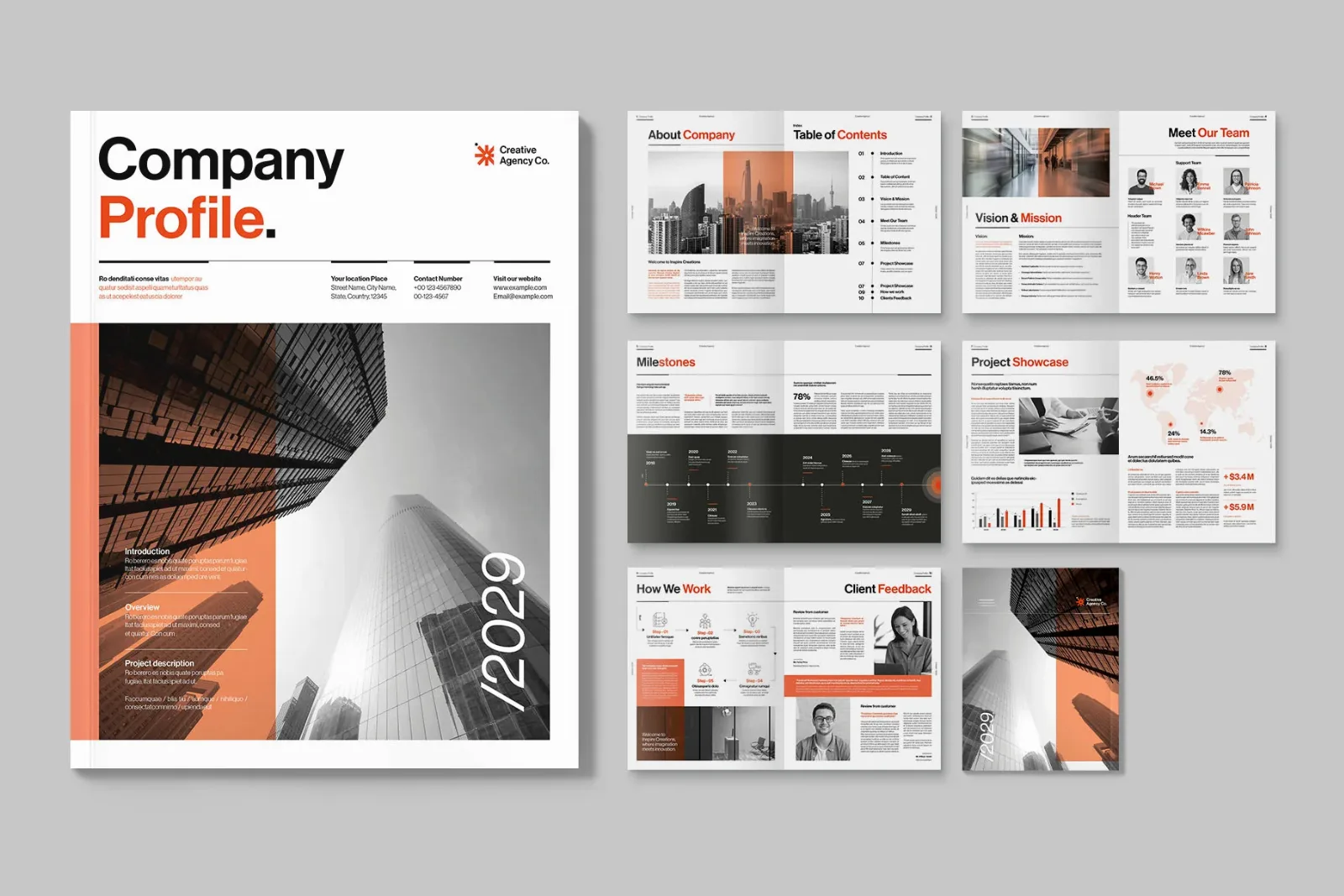
How to design a corporate profile that commands attention at board level — narrative arc, governance spreads, leadership pages, ESG sections, and metrics callouts.
A corporate profile serves a different audience and carries a different weight than a standard sales-focused company profile. It is read by board members, institutional investors, government officials, senior procurement committees, and strategic partners — readers who have seen thousands of such documents and can identify within the first page whether the organisation behind it commands genuine confidence. Creating an impactful corporate profile design requires more than good layout. It requires a considered narrative structure, governance-aware content, and visual choices calibrated for authority rather than personality. This guide covers the how-to in detail, from opening spreads through to ESG sections.
What "Impact" Means for a Corporate Profile
The word "impact" in the context of a corporate profile does not mean dramatic design or bold aesthetics. It means that the document achieves its intended effect on its intended reader — that a board member feels confident in the organisation's governance, that an institutional investor finds the financial narrative coherent and substantiated, that a government procurement official can quickly locate the compliance credentials they need.
Impactful corporate profile design is precise, authoritative, and easy to navigate under time pressure. Corporate readers skim first. They look for structure before they read sentences. They notice whether sections are clearly labelled, whether data is presented in a readable format, and whether the visual treatment is consistent with the level of professionalism the organisation claims.
Impact is also cumulative. No single design element makes a corporate profile authoritative — it is the combination of a confident opening, a coherent narrative, credible proof, competent governance disclosure, and consistent visual execution that produces the impression of a serious, well-run organisation. Weak execution in any one area — a sloppy leadership page, a metrics section with inconsistent formatting, a governance spread buried at the back — undermines the credibility built elsewhere.
The starting point for every impactful corporate profile is clarity about its primary audience and purpose. A profile designed for board distribution during an AGM has different requirements than one designed for an IPO roadshow, a CSR report supplement, or a government infrastructure tender. Defining the primary reader before designing a single page is not a preliminary step — it is the brief itself.
The Corporate Narrative Arc
The most persuasive corporate profiles follow a deliberate corporate narrative arc — a sequence of information that builds credibility progressively rather than presenting credentials in arbitrary order. Understanding this arc is what separates profiles that feel authored from those that feel assembled.
The arc typically moves through four phases. First, orientation: who we are, what we do, and what scale we operate at — communicated in the first two to four pages, quickly enough for a skimming reader to locate themselves. Second, substantiation: the evidence behind the orientation — financial data, track record, project history, certifications, and market position, presented with specificity. Third, leadership and governance: who is responsible for the organisation's performance, how decisions are made, and what oversight structures are in place. Fourth, future direction: strategy, expansion, ESG commitments, and the value proposition for whoever is reading.
Many corporate profiles invert or jumble this arc — opening with a lengthy history before establishing what the company does today, or burying the most persuasive proof points in the middle of the document. A reader who is confused or disoriented in the first few pages will skim or stop reading, regardless of the quality of what comes later.
The narrative arc also determines page allocation. If your primary purpose is investor engagement, financial performance and strategy sections deserve more pages than the company history. If the primary purpose is tender prequalification, certifications and completed project references earn prime placement. Allocate pages in proportion to what your primary reader actually needs, not in proportion to what is easiest to write.
Opening Spreads That Command Attention
The opening spread of a corporate profile — typically pages two and three after the cover — sets the tone for everything that follows. It is the first interior content the reader encounters and the most important opportunity to establish authority before any detailed information is presented.
An effective corporate opening spread usually contains one of the following: a chairman's or MD's statement that is substantive rather than ceremonial (not a generic welcome message, but a direct statement of performance, strategy, or commitment); a company overview spread that sets scale, sector, and reach in clear, specific language with supporting visual data; or a mission and values spread that expresses the organisation's purpose through specific operational commitments rather than abstract principle statements.
What the opening spread should not be: a full-page image with a tagline and nothing else (beautiful but not informative), a wall of small-print historical text that no corporate reader will engage with, or a logo-on-white opening page that repeats the cover without adding information.
Typography choices on the opening spread signal whether the document is designed for a corporate audience. Serif typefaces used for body copy convey tradition and authority; clean sans-serifs convey modernity and clarity. Neither is universally right — but both should be chosen deliberately in the context of the organisation's brand positioning, not defaulted to arbitrarily. Colour temperature matters here too: cool, restrained palettes read as corporate-serious; warm, saturated palettes read as brand-forward. Match the palette to the audience's expectations.
Leadership and Board Pages
Leadership story pages in a corporate profile serve a specific function: they tell the reader who is accountable and why that person is qualified to be. This is not a biographical indulgence — it is a risk-mitigation signal for investors, partners, and institutional buyers who need to know that the organisation is led by competent, experienced individuals.
Effective leadership pages include a professional portrait (consistent lighting, consistent background treatment across all team members), a headline statement that captures the individual's strategic role rather than just their title, and three to four lines of substantive biography covering relevant experience, sector knowledge, and specific qualifications. A CEO profile that says "Ms. Sharma has over 20 years of experience in the industry" conveys very little compared with one that specifies the industry, the organisations she led, and a notable outcome from her tenure.
Board pages follow the same principle at a governance level. For a corporate profile submitted to institutional investors or government bodies, a board governance spread should include each director's classification (executive/non-executive/independent), their relevant expertise area, and their committee memberships if applicable. This level of specificity signals governance maturity.
Avoid the common mistake of making leadership pages overly promotional. "Award-winning visionary leader" is not informative. "Former VP Operations at [relevant company type], with a track record of scaling manufacturing output by restructuring supply chain partnerships" is informative. The style should be authoritative and factual rather than celebratory.
Governance and Compliance Design
Governance spreads design is a specific challenge because the content — committee structures, audit frameworks, statutory information, compliance certifications — is inherently text-heavy and technically important, but also among the most skimmed sections of any corporate profile. The design goal is to make governance information scannable and credible without sacrificing the completeness that institutional readers require.
Use structured layouts with clear typographic hierarchy on governance pages. A governance spread might use a two-column layout: one column for organisational structure (presented as a simple visual chart or table), the other for certification listings with issuing bodies and validity periods. Visual separation between categories prevents the text from compressing into an unreadable block.
Certification pages should display each certification clearly — name, issuing authority, scope, and expiry or renewal cycle where relevant. If certificates are reproduced as images, ensure they are legible at the size they will be printed. Illegible certificate images are a credibility problem, not a design feature.
For profiles used in infrastructure tenders, PSU procurement, or defence supply chains, statutory registration details (company registration number, GST, PAN, relevant sector licences) should be clearly included in a dedicated page or well-labelled section. Tender evaluators often check for these details early. If they cannot find them quickly, the profile is less useful as a submission document.
Metrics and Data Callouts
Data presented well is one of the most powerful credibility tools in a corporate profile. Metrics callouts — key numbers set in larger type or designed as visual elements separated from body text — give corporate readers a fast, scannable path through the evidence without requiring them to read every paragraph.
Effective metrics callouts are specific and contextualised. "₹480 Cr revenue in FY 2025–26" is more credible than "significant revenue growth." "32 completed infrastructure projects across 8 states" is more useful than "extensive project portfolio." The callout should state the metric, its timeframe or scope, and ideally what it signifies — whether that is scale, track record, efficiency, or market position.
Be precise about what you can and cannot claim. If you are a privately held company, state the metric accurately based on internal data — do not approximate or inflate. If you are quoting industry comparisons or market position claims, be specific about the data source and date. Corporate readers who encounter inflated or unverifiable metrics immediately discount the entire document.
Design the metrics section with consistent visual treatment — a shared container style, consistent number formatting (crore vs million vs lakh should be standardised throughout), and a layout that allows each metric to breathe rather than competing visually. Four to six well-chosen metrics presented cleanly are more persuasive than fifteen metrics packed into a data table.
ESG and Sustainability Sections
ESG (Environmental, Social, and Governance) content is increasingly expected in corporate profiles submitted to institutional investors, listed companies' supplier panels, and government agencies with sustainability mandates. The challenge is presenting ESG commitments credibly without overstating what is actually in place.
The most credible approach to ESG sections is specificity without exaggeration. Rather than declaring "We are committed to sustainability," describe the specific initiatives underway: a renewable energy installation with actual capacity, a waste reduction programme with measurable targets, a community skill development initiative with participant numbers. Aspirational language without operational evidence reads as performative to experienced ESG evaluators.
Be honest about where you are on the ESG journey. A company that has begun environmental data tracking but has not yet achieved formal sustainability certification can say exactly that — "We commenced our ISO 14001 preparation in 2024 and are targeting certification by 2026" — which is more credible than vague language that implies a maturity not yet reached.
For smaller companies that are early in ESG formalisation, a single well-organised sustainability page that covers environmental practices, workforce welfare policies, and community contributions is sufficient and honest. For listed companies or those seeking institutional investment, a more structured ESG spread aligned to frameworks like GRI or BRSR will be expected. Match the depth of your ESG disclosure to what your audience genuinely requires, not to what sounds most impressive.
Frequently Asked Questions
How is a corporate profile different from an annual report?
An annual report is a periodic statutory document — typically mandatory for listed companies — that covers audited financial performance, board reports, and shareholder information for a specific financial year. A corporate profile is a marketing and positioning document that presents the organisation in its best light for external stakeholders. A corporate profile draws on financial data and governance information, but it is designed for persuasion and navigation rather than statutory completeness. Both serve important purposes; they are not interchangeable.
What page count is appropriate for a corporate profile?
Most corporate profiles run 20–36 pages, with larger organisations or more complex governance structures naturally requiring more space. The right page count is determined by the content requirements of the primary audience. An investor-facing profile for a mid-size listed company needs more depth than a sales-facing profile for an SME. Padding with repeated content or thin design spreads to reach a target page count always weakens the document.
Should ESG be a dedicated section or integrated throughout?
Both approaches work, and the right choice depends on how central sustainability is to the organisation's identity and strategy. Companies where ESG is a genuine differentiator — renewable energy firms, sustainable supply chain operators, B-Corp certified businesses — benefit from integrating sustainability messaging throughout rather than isolating it on a single page. Companies where ESG is an important but secondary consideration are better served by a dedicated, well-designed sustainability section that is thorough and honest.
How should a corporate profile handle sensitive governance information?
Include what is necessary for your audience's confidence and omit what is genuinely confidential or commercially sensitive. For institutional investors and listed-company suppliers, governance transparency is expected — committee structures, director classifications, and compliance certifications should be disclosed. For competitive tender submissions, statutory registrations and key certifications are necessary. Internal shareholder information, pending litigation details, or confidential financial projections are legitimately outside scope for a standard corporate profile.
Can a corporate profile also serve as a sales document?
With careful design, yes. The key is ensuring that governance-heavy content and sales-oriented content are clearly structured as separate sections, so each audience can navigate directly to the section most relevant to them. A corporate profile that flows logically from company overview to capabilities to governance to ESG serves both an institutional investor skimming for governance and a procurement manager skimming for capability evidence — provided the section structure is obvious and the navigation (whether through a table of contents or clear section dividers) makes it easy to find what is needed.
Design a Corporate Profile That Works at Every Level
A corporate profile that commands genuine confidence from institutional readers is the result of deliberate structure, honest content, and professional design executed with care. Whether you need a profile for investor presentations, government tender submissions, board distribution, or senior partner meetings, the standard required is the same: clear, credible, and authoritative.
See how our corporate profile design service approaches narrative, governance, and visual execution for B2B organisations across India. Explore the full process behind impactful corporate profile design — from content strategy to print-ready delivery. You can also read more about profile structure and design strategy in our design resource library.
---