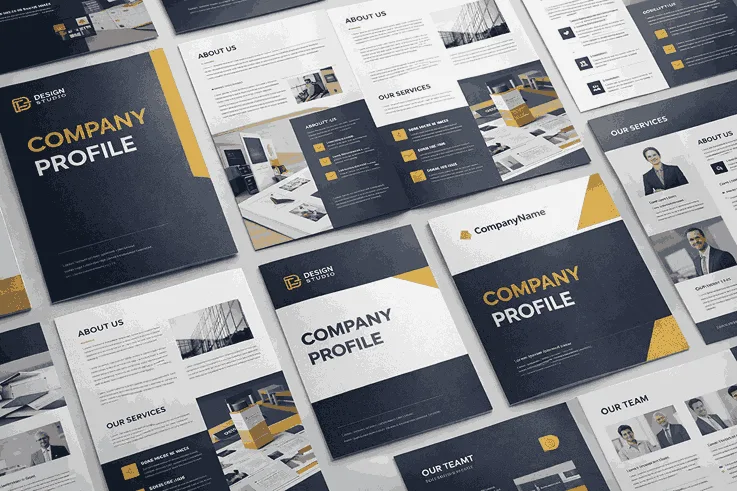
If you have ever opened a competitor's pitch deck and thought, "we need something like this," you already understand why company profiles matter. A well-made profile is the single document that introduces your business, builds credibility, and moves a prospect closer to a decision — before a single phone call happens. Yet most SMEs in India either skip it altogether or hand a designer a vague brief and hope for the best. This guide walks you through exactly how to make a company profile for your business: from drafting your first outline to exporting a print-ready PDF. Every step is practical, sequential, and written for founders and marketing managers who want the job done right.
Why Every B2B Company Needs a Company Profile
A website answers questions from visitors who find you. A company profile answers questions from people you send it to — a procurement officer reviewing tender submissions, an investor scanning your deck before a call, or a bank manager who needs to understand your business in five minutes. These are very different reading contexts. The profile gives you control over the narrative and the sequence in which information is presented. It is a curated document, not a browsable site.
For SME company profile India contexts specifically, the stakes are high. Government tenders, MSME portal registrations, and large enterprise vendor registrations almost always require a company profile as a PDF attachment. In those situations, a poorly designed or incomplete profile can eliminate your bid before evaluation begins — not because your work is weak, but because the document failed to communicate your strength. Think of your company profile as the best version of your company on paper: structured, consistent, and honest.
Beyond tenders, a profile shortens the sales cycle. When a prospect can read about you at their own pace before a meeting, the meeting becomes more productive. You spend less time explaining basics and more time discussing fit. That alone is worth the investment of creating a proper profile.
The Company Profile Outline Template
The most common mistake businesses make is jumping straight into writing without an outline. A solid company profile outline keeps every section purposeful and prevents you from either missing key information or padding the document with irrelevant content.
A reliable outline for most B2B companies looks like this:
- Cover page — Company name, logo, tagline, date or version number
- About Us — Founding story, mission, and what the business does in plain language
- Vision and Values — Where the company is headed and what it stands for
- Services or Products — What you offer, structured by category
- Industries Served — Sectors or client types you have genuine experience in
- Key Credentials — Certifications, registrations, awards, partnerships
- Team Overview — Founders and senior leadership with brief bios
- Contact Page — Full address, phone, email, website, GST number for tender profiles
Depending on your business model, you might add a portfolio or work samples page, a client categories page (listing industry types rather than named clients if confidentiality is a concern), or an infrastructure and capacity page for manufacturing companies. Keep the outline tight — eight to twelve pages is usually enough for most B2B profiles. Resist the urge to include everything; selectivity is a sign of confidence.
What to Write in Each Section
Once you have your outline, writing becomes a matter of filling each slot with the right kind of content. This is where most businesses either under-write (a three-line "About Us" that says nothing) or over-write (a page of generic claims with no proof).
For the About Us section, write two to three paragraphs. The first should say what you do and who you do it for in one or two sentences. The second should give context — how long you have been operating, the geography you serve, the scale you work at. The third can introduce your founding story or differentiation briefly. Avoid phrases like "one-stop solution" or "leading provider" unless you can prove them.
For Services, use a consistent structure for each offering: a heading, two to four lines of description, and if possible, a line about who this service is for. Do not simply list service names — that looks like a menu, not a conversation.
For Key Credentials, be specific. "ISO 9001:2015 certified" is better than "quality certified." A DPIIT recognition number is better than "government recognized startup." Specificity builds trust. This section is also where you can mention industries served, notable project types (without inventing client names), and any published recognition.
As part of your company profile content checklist, confirm that every section has: a clear heading, at least one concrete proof point or specific detail, and a logical connection to the section before or after it. If a section has none of these, rewrite it or remove it.
Gathering Assets Before You Brief a Designer
One of the biggest delays in any company profile project is the asset-gathering phase. Designers cannot start layout work without the right files, and incomplete assets mid-project mean revisions, extra costs, and missed deadlines. Before you brief any designer — internal or agency — collect the following:
- Brand assets: Logo files in vector format (AI, EPS, or SVG), not PNG or JPG cropped from a website. If you only have raster files, note this upfront.
- Brand guide: If you have one, share it. If not, share at least your primary and secondary colours (hex codes preferred) and any preferred fonts.
- Photography: Team photos, office photos, product or service photos. Minimum resolution for print is 300 DPI at the intended print size. For digital-only profiles, 150 DPI at full-page size is acceptable.
- Written content: All text, reviewed and approved by your team, in a Word document or Google Doc. Avoid sending content in email threads — it leads to version confusion.
- Reference profiles: Two or three competitor or aspirational profiles that show the visual direction you are aiming for.
Agencies that specialise in company profile design will often provide a detailed asset checklist during onboarding. Use it. The more complete your brief, the faster and better the output.
Design and Brand Alignment
Design is not decoration — it is structure made visible. A well-designed company profile uses layout to guide the reader's eye, whitespace to signal importance, and colour to reinforce brand identity. Poor design, on the other hand, forces the reader to work harder to extract information, which leads to them putting the document down.
Brand alignment means that the profile feels like it belongs to the same family as your website, business cards, and email signature. The logo placement, primary colours, and typography should be consistent across all touchpoints. If your website uses a clean sans-serif font, your profile should not suddenly use a decorative script.
For image resolution for print PDF, 300 DPI is the minimum standard. If your profile will only ever be shared digitally, 150 DPI at full-page size is adequate, but building at 300 DPI gives you print flexibility without a redesign later. Always set up your design files at A4 size (210mm × 297mm) unless your brief specifies a different format. US Letter is acceptable for international profiles, but A4 is the standard in India.
Consider hiring a professional company profile design agency for this phase if your internal team lacks layout experience. A trained designer will make choices — grid, margin, type scale — that a non-designer simply cannot replicate in PowerPoint or Canva, no matter how many templates are available.
Review, Approval, and Legal Sign-Off
Before the profile goes out into the world, it needs to pass through a structured review process. "Review" does not mean sending a PDF to your team and waiting for someone to reply. It means assigning specific reviewers, setting clear deadlines, and tracking changes in a single document.
A practical review workflow has three stages. First, a content review: does every factual claim check out? Are company registration numbers, GST details, and certification numbers accurate? Is all the contact information current? Second, a brand review: does the design comply with your brand guidelines? Are there any off-brand colours, font substitutions, or logo placement issues? Third, a legal or leadership sign-off: does someone in authority approve the document as a final representation of the company?
This three-stage process prevents the embarrassing situation of a profile going out with an outdated address, a wrong certification year, or a director's name misspelled. Build the review into your project plan with enough time — at least three to five working days — before the intended publication date.
Export Formats and Version Control
The final step in learning company profile PDF steps is the export phase. Most company profiles are distributed as PDFs, but not all PDFs are created equal. For digital distribution via email or portals, a compressed PDF optimised for screen (typically under 5MB for a 12-page profile) is ideal. For print, you need a high-resolution PDF with bleed settings and embedded fonts — a completely different export from the same source file.
Version control is often overlooked but is critical for profiles used in tender submissions. Name your files clearly: use a format like CompanyName_CompanyProfile_v1.0_2026-05.pdf. Every time you update the document — even for a minor change — increment the version number and update the date. This prevents the nightmare of submitting an outdated version to a tender portal or sending a client a profile that lists the wrong address.
Keep your source files (InDesign, Illustrator, or Figma) in a shared folder with the same version naming convention. If you worked with a design agency, request source files as part of your contract — you should never be dependent on the agency to make a simple text change. Agencies offering professional company profile design services typically hand over source files as part of their standard package; confirm this before signing.
A Final Word on Getting It Done
The most common reason businesses delay their company profile is perfectionism about content. A document that is 90% right and shipped is infinitely more useful than a perfect document that is still in draft. Start with the outline, fill in what you know, gather assets in parallel, brief a designer with what you have, and iterate. Your company profile is a living document — it should be reviewed and refreshed at least once a year as your business grows, your services evolve, and your credentials strengthen. The structure you build now makes future updates faster and cheaper.
Frequently Asked Questions
How long should a company profile be?
For most B2B businesses, eight to twelve pages is the ideal range. Short enough to be read in a single sitting, long enough to cover all key sections meaningfully. Businesses with extensive service lines or large infrastructure may stretch to sixteen pages, but anything longer risks becoming a brochure that nobody reads fully. Tender profiles sometimes need to follow a prescribed format and page limit set by the issuing authority — always check the tender document first.
Should I write the content myself or hire a copywriter?
You should provide the raw material — facts, figures, service descriptions, founding story — and have a professional copywriter shape it into clean, consistent prose. Founders often write in the first person with too much internal jargon, while a copywriter will translate that into clear B2B language. If budget is limited, write a complete rough draft yourself and have the copywriter polish it rather than starting from scratch.
What file format should I send to a designer?
Send your content in a single editable document — Google Docs or Microsoft Word. Avoid email threads with fragmented edits. For images, share them via Google Drive or WeTransfer in their original high-resolution format. Never embed images inside a Word document and send that to the designer — image quality degrades significantly when extracted from Word files.
How much does a company profile design cost in India?
Prices vary widely depending on the scope, number of pages, and the agency's experience level. Freelance designers may charge anywhere from ₹5,000 to ₹25,000. Specialist agencies with copywriting, photography direction, and multiple revision rounds typically range from ₹25,000 to ₹1,50,000 for a full-service project. Be wary of very low quotes — they usually mean fewer revisions, no source files, or templated work with minimal customisation.
How often should I update my company profile?
At a minimum, review and update your profile once a year. Key triggers for an immediate update include: a change in your registered address or contact details, a new certification or award, a major expansion of services, a change in leadership, or a rebranding exercise. Profiles with outdated information actively damage credibility — a profile that lists a closed office or an expired certification is worse than no profile at all.
Ready to Build Your Company Profile?
You now have everything you need to start: an outline template, a content checklist, an asset list, and a review workflow. The next step is to put it into practice. If you would rather work with specialists who do this every day, the team at Company Profile Design can take your brief from outline to print-ready PDF.
Explore our company profile design service to see how we work, what's included, and how to get started. Or if you'd like to browse examples and articles on related topics, visit our blog for more practical guides.
A strong company profile is not an expense — it is the document that earns the meeting. Start building yours today.