Building a professional company profile has traditionally required weeks: gathering content, briefing a designer, reviewing drafts, consolidating feedback, and exporting final files. That timeline works well for businesses that need a deeply customised, long-form profile — but there is a large category of companies that need a clean, professional, print-ready profile much faster and at a lower cost. That gap is exactly what the Funky Developers automated company profile design flow was built to address. This post explains the problem in detail, describes who the tool is designed for, walks through how the automated flow works step by step, and is honest about what it does well and what still needs a human hand.
The Problem We Built This to Solve
The company profile design market in India has two ends with very little in the middle. At the high end, full-service design agencies offer deeply customised profiles with discovery sessions, professional copywriting, multiple revision rounds, and bespoke layouts — at costs that are appropriate for the value delivered, but out of reach for many early-stage businesses, solo founders, and smaller SMEs. At the low end, freelancers and template services offer quick but generic results that often feel interchangeable — the same layout, the same stock photos, the same vague claims applied to any business in any sector.
The businesses that fall through the gap are those with real content and a real brand — they know what they want to say, they have their assets ready, they just need a fast, affordable way to get from content to a polished PDF without months of back-and-forth or a generic template that looks like it came from a wedding invitation website. These businesses do not need extensive discovery or copywriting — they need a structured, professional layout delivered quickly, with enough flexibility to reflect their specific brand and content.
A secondary problem is geographic. Businesses in tier-2 and tier-3 cities in India often struggle to find credible local design talent with B2B PDF experience. The company profile builder India flow removes geography from the equation — the entire process runs remotely, with no dependency on local availability.
Who This Is Designed For
The automated flow is designed primarily for three types of clients. The first is early-stage businesses — companies that have been operating for one to three years, have a clear offering, and need a professional profile to begin pursuing corporate clients, applying to tender portals, or registering as vendors with enterprise buyers. They have content but may not have a developed brand identity beyond a basic logo.
The second is established SMEs that need a quick refresh. Their existing profile is two or three years old, the design is dated, but the content only needs modest updates. A full redesign project is disproportionate to the actual change required — the automated flow allows them to get a refreshed, current-looking profile without commissioning a full bespoke project.
The third is businesses that need a self-serve profile design alongside a larger project. For example, a company commissioning a new website may want a matching company profile but does not want to wait for the website project to complete before having something to send to clients. The automated flow can produce a draft profile in days, giving the business something professional to use while the larger project progresses.
The flow is not designed for companies that need deeply customised layouts, extensive photography direction, or multi-language versions — those projects are better served by the full-service company profile design service, which involves a structured discovery process and dedicated design time.
How the Automated Flow Works (Step by Step)
The automated flow is built around a structured input process that gathers everything needed to produce a professional profile before any design work begins. Here is how it works:
Step 1: Content intake form. The process begins with a structured intake form that guides the client through every section of the profile: company name, registered details, founding year, About Us description, vision and values, service or product listings, key credentials, team overview, and contact information. The form includes character-limit guidance for each section (so clients do not write too much or too little) and examples of well-written content for each field. The entire form typically takes 45–90 minutes to complete for a client who has their information ready.
Step 2: Brand asset upload. Alongside the content form, the client uploads their brand assets: logo files (vector preferred, but high-resolution raster accepted), brand colour hex codes, preferred fonts if any, and any photography they want included. If no photography is available, the system uses a professionally curated library of industry-appropriate images that can be filtered by sector. Stock image selections are reviewed by a human team member to ensure they are contextually appropriate and not visually generic.
Step 3: Template selection and customisation. The client selects from a library of professionally designed base templates, each built on a grid system with consistent typographic hierarchy. Templates are grouped by industry category (manufacturing, services, technology, professional services, infrastructure) and by visual style (clean minimal, bold accent, executive formal). The selected template is then automatically customised with the client's brand colours, logo placement, and typography preferences.
Step 4: Automated layout generation. The content from the intake form populates the customised template automatically. The system applies the defined typographic hierarchy, places images, generates section breaks, and produces a first draft PDF. This step takes minutes, not weeks. The draft is automatically reviewed by an algorithm for common issues: text overflow, image aspect ratio problems, missing sections, and colour contrast failures.
Step 5: Human review and refinement. This is the step that separates the automated flow from a pure self-serve tool. Every draft generated by the system is reviewed by a member of the design team before it reaches the client. The reviewer checks for contextual appropriateness, brand consistency, content coherence, and anything the algorithm cannot catch — for example, a company description that contradicts the services listed, or a certification that appears inconsistent with the industry the company operates in.
Step 6: Client review and revision. The reviewed draft is shared with the client as an annotated PDF with instructions for feedback. One structured revision round is included in the standard package, covering content corrections, image swaps, and minor layout adjustments. The revised document is then exported in both screen-optimised and print-ready PDF formats.
What You Get
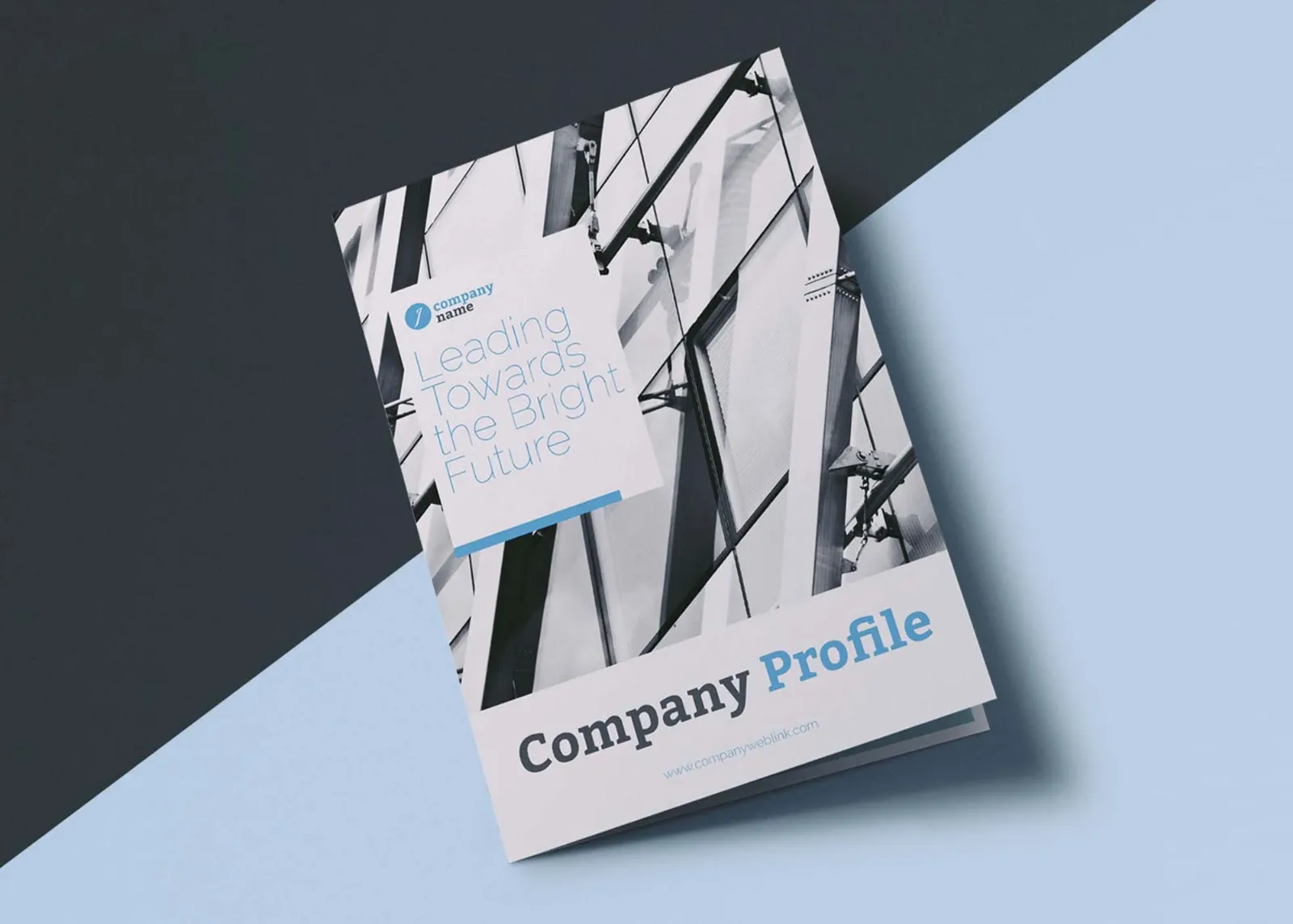
A standard output from the automated flow includes: a 10–14 page professionally designed company profile PDF in two versions (screen-optimised under 5MB, print-ready with bleed and CMYK colour settings), a cover page and contact page matching the interior design, an optional additional "Credentials and Certifications" page if the content warrants it, and a file naming convention ready for version control.
Clients also receive a brief style guide for the profile — the specific colour codes, font names, and image style directions used in their document — so that future updates or related materials (letterheads, presentation templates) can maintain visual consistency. This is not a full brand guide, but it is enough to brief a designer for future work without starting from scratch.
What Still Needs a Human Touch
Honesty about limitations is important here. The automated flow produces excellent results for clients with clear, well-written content and basic brand assets. It does not replace the judgment, creativity, and strategic thinking that a dedicated design team brings to a complex brief. Specifically, human review company profile work remains necessary for several scenarios.
Content strategy and copywriting: if the client's content is weak, vague, or not yet written, the automated flow will not improve it — it will simply present poor content in a professional layout, which is a waste of design quality. Clients who need copywriting support should opt for the full-service offering. Photography direction: the automated flow can place provided images or select from a stock library, but it cannot direct a photography session, brief a photographer, or advise on what scenes to capture. A hybrid template and custom design approach — using the automated flow for layout and adding custom photography as an upgrade — is available for clients who want this level of quality.
Complex multilingual layouts, bespoke infographic design, and profiles exceeding sixteen pages are also outside the automated flow's scope. These require dedicated design time and are handled as full-service projects.
Security and Privacy
Company profile content contains sensitive business information: financial indicators, ownership structure, certification details, and sometimes client category information. The automated flow processes all client-submitted data on secured servers with access controls limiting visibility to the review team handling that specific project. Content submitted through the intake form is not stored beyond the project duration — once the final files are delivered and the client confirms receipt, the submission data is deleted from active storage within thirty days.
Clients who require a formal NDA before sharing business information can request one before beginning the intake process. The NDA is mutual — it covers both the client's information and any proprietary aspects of our process. For businesses in regulated industries or those submitting profiles to sensitive procurement processes, the NDA is strongly recommended.
Pricing Approach
The automated flow is priced as a flat-rate package that includes the intake form, automated layout generation, human review, one revision round, and both PDF exports. The pricing is designed to be meaningfully lower than a full-service bespoke project while reflecting the real cost of the human review step — this is not a no-touch automated tool, and the pricing reflects that.
[INSERT PRODUCT URL for current pricing and package details. Pricing information is subject to change and should be confirmed on the product page at launch.]
Optional add-ons including additional revision rounds, copywriting for specific sections, custom photography sourcing, and multilingual page versions are available at stated incremental rates. All add-on pricing is confirmed before any work begins — there are no surprise charges.
Frequently Asked Questions
How long does the automated flow take from intake to final PDF?
The standard timeline from completed intake form submission to delivery of the first draft is three to five business days. This includes automated layout generation, human review, and any initial corrections identified by the reviewer before the draft reaches the client. One revision round typically completes within two to three additional business days. Total time from start to final approved files is typically seven to ten business days — significantly faster than the three to six weeks typical of a full bespoke project.
What happens if I am not happy with the output?
One revision round is included in the standard package. If, after the revision, the output still does not meet your requirements because of fundamental mismatches between the template aesthetic and your brand expectations, we will discuss options — including upgrading to the full-service project or selecting a different base template and regenerating the layout. Our goal is a client who is genuinely satisfied with the document, not one who has technically received their revision round. Edge cases are handled on a case-by-case basis, and we will always be transparent about what is and is not within scope.
Can I use the automated flow if I only have a PNG logo, not a vector file?
Yes, with a caveat. High-resolution PNG logos (minimum 500px wide at their intended display size) can be used in the layout, but they are not suitable for print at large sizes without quality degradation. We recommend using a PNG logo for the digital version and noting that a vector file will be needed for print. If you do not have a vector logo, we can discuss a separate logo vectorisation service as an add-on before the project begins.
Will my profile look identical to other clients who chose the same template?
No. Every profile is customised with the client's specific brand colours, logo, typography preferences, photography, and content. While two profiles built on the same base template will share structural similarities (grid, section layout, type hierarchy), the visual experience will be distinctly different because colour, photography, and content are the primary drivers of visual identity in a designed document. The templates provide a professional structural foundation; the customisation makes each profile unique.
Is the automated flow available for businesses outside India?
The automated flow is currently designed and optimised for Indian B2B businesses — the content structure, compliance details guidance, and template library reflect Indian market conventions. International clients can use the service, but some India-specific sections (GST, MSME registration) will not be applicable and can be replaced with relevant local compliance details. We are actively developing template variants for Gulf market and Southeast Asian client contexts — check the product page for current availability.
Try the Automated Flow or Speak to the Team
If you need a professional company profile quickly, at a clear flat rate, with a human review step built in, the automated flow is designed for you. It is honest about what it does and does not include, and it is priced to reflect real value rather than cutting corners on the review process.
[Visit the automated flow product page at INSERT PRODUCT URL to start your intake form or see sample outputs.]
If your project needs more than the automated flow offers — complex customisation, copywriting, multilingual layout, or a profile designed for a high-stakes investor or tender context — our full-service company profile design offering is the right starting point. You can also explore related articles and design guidance on our blog.
Either way, a professional company profile is not a luxury — it is the document that earns the conversation. Get started with Company Profile Design today.