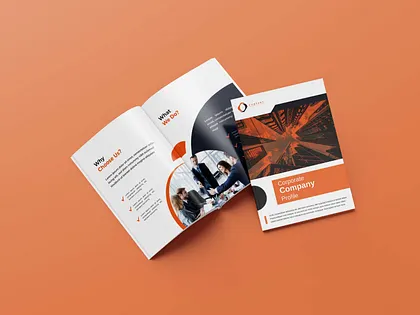
The question comes up regularly in marketing conversations: "If we have a good website, do we really need a company profile?" It is an understandable question — both are brand documents, both communicate what the company does, and both require investment. But the question itself reveals a misconception. Company profile design vs website is not a choice between competing formats: it is a question of which format serves which job. A website and a company profile are built for different reader contexts, different distribution channels, and different communication objectives. Understanding that distinction clearly helps you invest appropriately in both — and avoid the waste of trying to make one format do a job it was never designed for.
Definitions: What Each Format Is
A company website is a publicly accessible, searchable, self-updating digital platform. It is found via search engines, social media, and direct navigation. It supports non-linear exploration: visitors choose their own path through menus, links, and search. It is optimised for discovery — attracting people who are actively looking for what you offer. It handles SEO, lead capture, and ongoing content publishing. The website is always on, accessible from any device, and updated without printing or distribution.
A company profile is a structured document — typically a PDF — designed for direct distribution to a specific recipient in a specific context. It is not discovered via search in the conventional sense; it is sent, submitted, or handed over. It presents a curated, linear narrative: the reader follows the document's sequence rather than choosing their own path. It is a snapshot in time, accurate as of its publication date. It serves formal contexts — tender submissions, investor packs, email introductions, printed handouts — where the format, completeness, and presentation of a structured document are expected or required.
Neither format is superior. Each serves its context well. The confusion arises when businesses try to use one as a substitute for the other.
How Websites and Profiles Serve Different Reader Contexts
The website reader arrives with a question and navigates to find the answer. They may spend three minutes or thirty; they may read one page or twenty. They are in control of their experience and can exit at any point. The website's job is to engage this reader efficiently, answer their question quickly, and move them toward a specific action (enquiry, download, sign-up).
The profile reader receives a document they did not necessarily seek out. They are reading it because someone sent it to them — a sales contact, a procurement portal, a pitch process. Their question is not "what does this company offer?" but rather "does this company meet our criteria?" They are evaluating against a checklist, often in parallel with several other profiles. The PDF narrative vs web navigation contrast is fundamental: the profile must deliver its complete case in a fixed sequence, because the reader may not return to it after the first read.
Understanding this distinction shapes content decisions. Your website can afford to leave some questions unanswered, because the reader can navigate deeper to find more detail. Your profile cannot — it must answer the evaluator's core questions on the first read, in a sequence that builds the case logically. This is why generic, template-based profiles so often fail: they are built to look like profiles without being designed to serve the specific evaluation context the reader is actually in.
Update Cadence Comparison
Websites are updated continuously. Blog posts, news items, service changes, team updates — a well-maintained website reflects the business in near-real-time. This is one of the website's primary advantages for SEO and for inbound audiences who visit repeatedly over time.
Company profiles operate on a different update cadence. The typical update cycle is annual, or triggered by a significant business change: a new service offering, a certification renewal, a leadership change, a rebrand, or a major expansion. Profiles do not need to be updated as frequently as websites — in fact, updating a profile too frequently (more than twice a year) usually signals that the content strategy is not settled, and it creates confusion when multiple versions are in circulation.
The practical implication: your website handles the real-time communication job. Your profile handles the structured, periodic communication job. Build your content workflow accordingly — invest in a content management system and regular publishing for your website, and invest in a proper version-controlled design process for your profile. Trying to update a profile with the same frequency as a website is wasteful; treating a website as a once-a-year-update document is an SEO disaster.
SEO Ownership Belongs to the Website
This point is worth stating explicitly, because some businesses invest significant effort in their company profile and then wonder why their search rankings are not improving. SEO ownership belongs to your website, not your PDF. Search engines can index PDFs, but they do not rank them as highly as HTML pages for most informational queries, and PDFs do not build the domain authority that makes your other pages rank better over time.
If your goal is to be found by people searching for "company profile design agency in Mumbai" or "industrial equipment supplier India," that work belongs on your website — on landing pages, blog articles, and your services pages. Your company profile PDF serves the people who have already found you or been referred to you; it is not a discovery tool. Conflating the two leads to underinvestment in website SEO and false expectations about what a company profile can do for organic reach.
Messaging Consistency Rules
While the two formats serve different contexts, they must communicate the same brand. Messaging consistency means that the company name, tagline, service descriptions, value proposition, and visual identity must be identical across both formats. A prospect who reads your profile before visiting your website must not encounter a different positioning, a different set of services, or a different visual brand. Inconsistency between the two creates confusion and reduces trust.
Specific elements that must be synchronised: registered company name (exactly as it appears on compliance documents), GST number and CIN (in contexts where these appear on the website), all contact details, the list of services offered, any statistical claims about scale or experience, and certification details. If your website says you have been operating for fifteen years and your profile says twelve, that discrepancy will be noticed by diligent evaluators and will raise questions about which other details might be inaccurate.
Build a simple "brand consistency checklist" — a single-page document listing these synchronised elements and their current correct values — and review it when either the website or the profile is updated. This takes thirty minutes a year and prevents a category of credibility errors that are completely avoidable. For a structured approach to maintaining this consistency, our company profile design process includes a content alignment review as a standard step.
Common Duplication Pitfalls
The most common duplication problem is writing the same content for both formats and then wondering why neither document is compelling. Websites and profiles have different content rhythms. Website content is written for scanning — short paragraphs, clear headings, hyperlinks for depth. Profile content is written for sequential reading — longer paragraphs are acceptable, headings are structural rather than SEO-driven, and the narrative builds page by page.
A second duplication problem is using the same set of images in both formats without optimising for the medium. Images on a website should be compressed for fast loading; images in a print-ready profile need to be high resolution. Using the same compressed web image in a print profile results in blurry output. Build a proper asset library that maintains both web-optimised and print-optimised versions of all brand photography.
A third pitfall is building a profile that essentially mirrors the website's navigation structure — About, Services, Team, Contact — without taking advantage of the profile's unique opportunity to tell a structured story that no website can replicate. The best profiles use the fixed sequence of pages to build an argument: here is the problem our clients face, here is how we approach it, here is the evidence that our approach works, here is who to speak to. This narrative arc is impossible on a website where the reader controls the path.
When They Work Together Best
The profile and the website work together most powerfully when they are designed as a system. Specifically: use the profile to handle the contexts where a structured, distributable document is required — tenders, investor diligence, email introductions, sales meetings, partner onboarding — and use the website to handle everything else: discovery, SEO, ongoing content, lead capture, and real-time updates. Cross-link them thoughtfully: the profile's contact page should reference the website; the website should have a page where prospects can request or download the profile.
A well-integrated approach also means that key messages are consistent but not identical. The website explores; the profile persuades. The website invites discovery; the profile presents a complete case. When both formats are doing their distinct jobs well and pointing to each other at the right moments, the overall brand communication is stronger than either could achieve alone. If you are working on aligning your profile and website, talk to our company profile design team — we regularly advise on how to use both documents as part of a coherent brand communication strategy. You can also find related reading on our blog.
Frequently Asked Questions
If my website is up to date, why can't I just send a link instead of a company profile?
In many informal sales contexts, a website link is a perfectly acceptable alternative. However, in formal contexts — tender portal submissions, investor data rooms, bank financing applications, large corporate vendor registrations — a structured PDF document is either mandatory or strongly expected. The PDF also serves contexts where internet access is unreliable or where the recipient wants to share the document with colleagues who may not visit the website. A link transfers navigation control to the reader; a document transfers it to you.
Can a single document serve as both a company profile and a capabilities presentation?
Yes, with careful design. A capabilities presentation (typically used in formal pitch contexts) can be structured as a company profile with an additional section addressing the specific opportunity or project. This hybrid approach works well for businesses that frequently pitch for large projects and want to reduce the number of documents in circulation. The key requirement is that the base company information (credentials, team, contact) is consistent across both uses, and that the capability-specific section is clearly marked as project-specific.
How often should I align my website and company profile content?
Conduct a formal alignment check whenever you update either document significantly. At minimum, check annually. Specific triggers for an alignment check include: a service change (add or remove a service from one document, check the other), a rebranding exercise, a change in leadership or key team members, a new certification or the lapse of an existing one, and any change to contact details or registered office address. The consistency check itself takes less than an hour if you maintain the synchronisation document described in the Messaging Consistency section above.
Should my company profile and website have the same visual design?
They should share the same visual brand — logo, colour palette, typography, and photographic style — but the layout and design language will naturally differ because the formats have different constraints. A website layout is built for screens, responsive design, and user navigation. A profile layout is built for fixed pages, print margins, and sequential reading. Trying to make them look identical typically means compromising one format or the other. The goal is that a reader who encounters both formats feels a clear and consistent brand identity, not that the two look like screenshots of each other.
Build Both. Build Them Well.
The company profile and the website are different tools for different jobs — but they are tools in the same toolkit, serving the same brand and the same business objective. Invest in both, keep them aligned, and use each for the context it was designed for. The businesses that do this consistently build stronger brands and win more of the formal evaluation processes where structured documents are the deciding factor.
If your profile is overdue for a refresh, or if you are building one for the first time alongside a website update, our company profile design service is a practical starting point — we work alongside your web team to ensure brand consistency across both formats.