Blog
Company Profile Design Services: What You Actually Get (Brief to Handover)
By Funky Developers • 2026-05-13
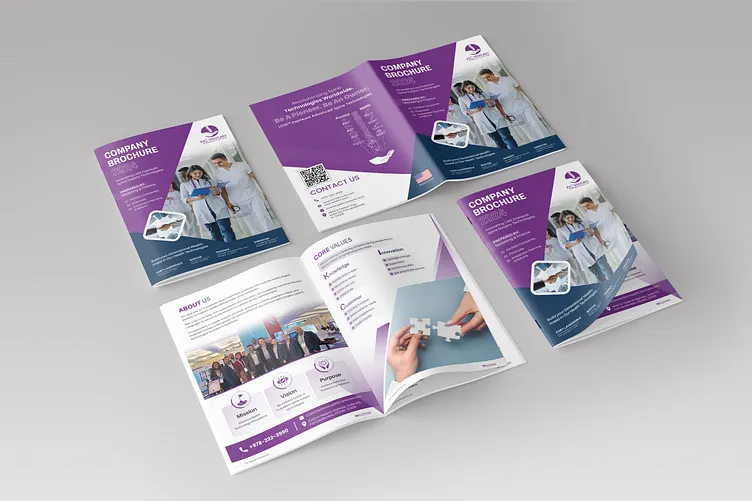
See what company profile design services include—research, copy, layout, revisions, and deliverables—so you brief vendors once and avoid scope creep.
Buying creative work is easier when you know the boxes on the checklist. Company profile design services vary by studio, but serious engagements usually bundle discovery, narrative structure, visual design, production, and file handover—not just “someone who knows InDesign.” This article walks through what to expect so you can compare proposals apples to apples.
Discovery: the phase that prevents expensive redraws
Good services start with questions: who reads this document, in what order, and what decision you want after page twelve? Workshops or structured interviews pull out proof points, service boundaries, and sector language procurement teams expect. Skipping discovery is how you end up with beautiful spreads that omit the one metric the tender template demands.
Company profile copywriting: voice, facts, and legal hygiene
Even design-led studios either write in-house or partner with copy specialists. Company profile copywriting turns scattered bullet points into a single voice, aligns claims with what sales actually says in rooms, and flags risky superlatives. You still own factual accuracy—finance signs numbers, legal signs partner names—but the writer keeps tone consistent from cover to back page.
Layout, art direction, and data-heavy spreads
Once narrative structure locks, designers build master pages: grid, type scale, rules for photography and icons, and styles for tables you will reuse every quarter. Charts and timelines should share one visual language so the document feels authored, not pasted from six older decks.
Design revision rounds: how many is fair?
Contracts usually specify two or three design revision rounds within scope. A round is not “change every comma”; it is a batched set of feedback on agreed spreads. Out-of-scope changes—new sections, new photography shoots, wholesale rebrand pivots—extend timelines and cost. Clarify what counts as a round before you sign so both sides stay sane near deadlines.
Profile design deliverables you should ask for
Clear profile design deliverables protect you after launch. Typical asks include high-resolution PDF for print, optimised PDF for email, packaged InDesign or Affinity source files if purchased, font licensing proof, linked asset folders, and a short style cheat sheet for in-house tweaks. If you only receive a flattened PDF, small text updates become painful.
Print and digital profile formats
Ask how your studio handles print and digital profile formats. Digital-first PDFs may use RGB assets and hyperlinked contents; print vendors need CMYK, bleed, and embedded fonts. Some clients also want PowerPoint or Keynote distillations of the same story—negotiate that up front because reflow is real work, not a quick export.
Pricing models you will see in the market
Studios price company profile design services using fixed project fees, phased milestones, or day rates. Fixed fees work well when scope is clear—page range, number of charts, photography supplied versus commissioned. Day rates help when discovery might expand because stakeholders multiply. Either model succeeds when change control is explicit: what happens when legal adds a new compliance section two days before export.
Be wary of quotes that skip discovery entirely or promise unlimited revisions. Unlimited rounds rarely survive contact with reality; they either hide cost elsewhere or burn out the team that supports you long term.
What a strong creative brief includes
Your brief should name audiences in priority order, list mandatory sections, specify maximum page count, identify competitors whose tone you admire or avoid, and attach examples of old profiles that failed. Call out languages if you need bilingual layouts. Mention file ownership expectations up front so profile design deliverables do not become a last-minute negotiation.
Good briefs also define success: “procurement uploads without rejection,” “investor meeting leave-behind,” “sales team stops rebuilding slides.” Designers use those outcomes to choose pacing, density, and proof style.
Quality checks before you approve print or upload
Run a consistency pass: spelling of company name, legal entity names, currency labels, date formats, and hyphenation of product names. Zoom to 100 percent on a representative laptop screen and on a phone. Print one laser proof if offset printing matters. Click every hyperlink in the company profile PDF and confirm destinations.
Assign one accountable signatory per department—marketing for voice, finance for numbers, legal for claims, leadership for bios—so feedback does not contradict itself across design revision rounds.
Collaboration rhythms that keep company profile design services on schedule
Most delays are organisational, not creative. Weekly checkpoint calls beat endless Slack threads because decisions get logged. Shared review PDFs should carry a version number in the footer so nobody comments on stale pages. When marketing wants warmth and legal wants caution, resolve tension in a single meeting with the designer present—visual people often propose compromises that satisfy both sides faster than email chains.
If multiple agencies touch your brand simultaneously—website, events, product packaging—nominate one brand guardian who approves palette shifts before they reach your profile. Small colour drifts across agencies multiply into obvious mismatches on a single spread that combines product photography and UI screenshots.
Post-handoff: who owns quarterly number updates
Company profile design services should end with a maintenance plan, even if informal. Decide whether marketing, corporate communications, or finance updates KPI tables. Train at least two people on your side to edit paragraph styles safely. Keep a change log in a spreadsheet: date, section, approver, file version uploaded to the portal. That discipline prevents “ghost” profiles circulating on sales laptops.
When major rebrands land, budget a full revisit rather than patching logos onto old grids. Typography and spacing tuned for a previous marque rarely survive a new wordmark without awkward gaps or unlawful clear-space violations.
Fonts, stock imagery, and partner logo compliance
Even perfect layouts fail export if font licences do not permit embedding. Ask your studio for receipts or licence statements for any commercial typefaces. For stock photography, confirm seats and redistribution rights—some licences forbid use in tender documents. Partner logos need written approval and correct colour reversals; designers should never stretch vector marks to fit a leftover box.
Build a small “asset bible” alongside the profile: approved logo pack, colour hex values, icon SVG set, and photography with model releases if people appear. This reduces emergency Slack hunts when someone needs a PNG at midnight before a flight.
When procurement and marketing disagree on tone
Procurement wants neutral, audit-friendly language. Marketing wants punchy differentiation. Instead of letting each side edit the InDesign file directly, run a facilitated sentence-level pass with your agency. Designers can propose dual-tone solutions: neutral body copy with a short manifesto-style opener that legal has already approved. Document the decision so the next refresh does not reopen settled debates.
Annexures, addenda, and portal upload quirks
Many portals cap file size, forbid embedded JavaScript, or reject RGB-only exports. Ask your studio to produce a “portal-safe” variant alongside marketing-rich PDFs. If you must append signed certificates as separate annexures, design the core profile so cross-references (“see Annexure A”) stay accurate when page numbers shift. Company profile design services teams that ship tenders weekly already maintain export presets for common government upload validators—borrow their checklist rather than discovering failures at 2 a.m.
FAQ
Should SEO keywords drive the copy?
Write for humans first. If a phrase fits a heading naturally, use it. Forcing repetition reads weak to evaluators and investors.
Who approves final print?
You should run a physical proof for large batches. On-screen approval misses paper shift and ink limits.
What if we only have a week?
Rush fees and reduced rounds are common. Honest studios will tell you what quality is achievable instead of promising magic.
How do we keep internal teams from editing the wrong file?
Publish a single canonical link from your intranet or DAM, restrict edit permissions on source packages, and run quarterly reminders in sales meetings. Naming discipline beats hero policing.
Sample SOW clauses that save arguments later
Ask your legal team to include explicit definitions: what counts as a revision round, how many business days the studio has to respond after receiving batched feedback, and what happens if your approver goes silent for ten days mid-project. Include file ownership, font licensing responsibilities, and whether print management sits in scope. These clauses feel bureaucratic until they prevent a midnight dispute about who pays for an extra illustration.
Also specify review formats—PDF markup only, no inline edits inside packaged source files by unauthorised staff—and a single named client approver who can authorise schedule changes. Company profile design services run smoother when governance matches the seriousness of the document you are shipping.
Add a short media retention clause: how long backups live, who may delete them, and how to request destruction if your engagement ends. For regulated clients, that clause matters as much as creative talent.
Digital-first versus print-first production tracks
The most overlooked decision in company profile design services is whether to start from digital constraints or print constraints. They are not the same file. Digital-first profiles optimise for screen: single-column reading flow, RGB colour space, hyperlinked section navigation, and file sizes that email servers accept without mangling. Print-first profiles start from bleed margins, CMYK ink limits, minimum font sizes for offset or digital press, and paper weight decisions that affect cost. Many studios produce both, but they should start from different assumptions—not apply a digital PDF filter to a print-ready master at the end.
Ask prospective studios which track they design from by default. If they answer "both, always," probe how they handle colour-space management when photography spans both uses. RGB photography converted to CMYK at export without profile matching often shifts blues and skin tones in ways that embarrass CMOs at major conference prints. A studio that plans output profiles from day one avoids those last-minute colour panics. For most Indian B2B clients, the practical reality is digital-first with a print-capable export as a secondary deliverable—but that decision should drive the grid and image resolution plan, not arrive as an afterthought request the day before a trade fair.
Profile design deliverables should therefore list both: an email-optimised PDF under 5MB and a print-ready PDF with bleed, crop marks, and embedded fonts. If your CMS or DMS requires a specific maximum file size for portal uploads, name that constraint in the brief. Many procurement portals in India cap uploads at 10MB or 25MB. Designers who know those constraints will compress smartly—not randomly—so resolution drops where it is acceptable (background textures) rather than where it matters (data tables, certifications, close-up process photography).
Measuring the return on your profile investment
Finance and procurement teams rarely ask "did the profile look great?" They ask whether the investment earned its cost. Measuring that is genuinely difficult for a document, but proxy indicators help: bid win rate before and after a major redesign; sales cycle length for deals where the profile replaced ad-hoc presentations; feedback collected from procurement leads who specifically named the profile as a differentiator; and internal savings from stopping the annual slide-rebuild ritual. None of these metrics are perfectly clean, but combining two or three creates a plausible case for the next refresh investment.
If your company profile copywriting team tracks document opens with gated links, compare section dwell time before and after the redesign. Stakeholders re-reading your methodology section or returning to your client reference spread signal that the content built enough trust to invite scrutiny. A profile that earns a second read is already outperforming a brochure recipients file immediately. Pair quantitative signals with anecdotes from your sales team: which spreads prompt questions in live walkthroughs, and which prompt the uncomfortable silence that means confusion has replaced curiosity.
Build a simple refresh trigger list: when the win rate in a key sector drops below a threshold, when a new service line accounts for more than twenty percent of revenue, when leadership changes by more than two people in a calendar year, or when a competitor profile clearly outperforms yours in a documented bid. These triggers remove the "should we update the profile?" debate from the realm of creative preference and put it into the same decision framework as a website refresh or a product brochure review. Operational discipline around design revision rounds extends the document's useful life and reduces the cost of each subsequent refresh.
Long-term value in company profile design services
The full value of strong company profile design services shows over a twelve-to-twenty-four-month horizon, not in the week of launch. A well-structured master system—clean paragraph styles, a modular page library, a consistent chart framework—allows your team to refresh individual sections without rebuilding the full document. That agility means quarterly metric updates cost an hour rather than a day; a new service line integrates cleanly rather than breaking layout discipline. The up-front investment in system thinking pays back every time you avoid a crisis rebuild before a tender deadline.
Look for studios that explain their system logic during the pitch, not just show beautiful spreads. How do they structure styles? How do they handle ongoing updates? What handover materials do they provide? Answers to those questions predict long-term value more reliably than portfolio impressiveness alone. The best company profile copywriting and layout partnerships evolve into ongoing creative relationships—studios that know your brand, your sector, and your stakeholder politics well enough to skip the briefing overhead on every subsequent sprint.
Work with a team that scopes clearly
If you need a partner who can carry discovery through production, our company profile design services page outlines how we structure projects, revisions, and handover. We focus on documents procurement and leadership teams trust.
Ready to talk timelines and profile design deliverables? Start from company profile design and send your sector, page range, and any mandatory tender sections—we will respond with a sensible plan.
For a single hub that explains how we run discovery, writing, and production, bookmark our company profile design services detail page before you brief internal stakeholders.
Related: company profile design services (homepage) · company profile design agency · get a quote.